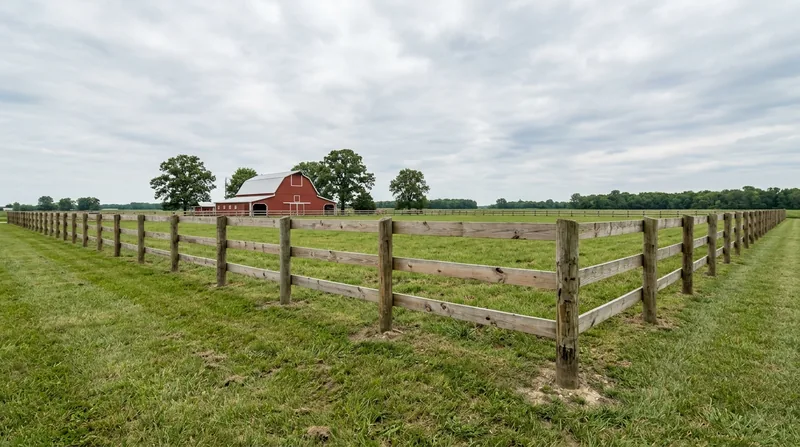




Farm fence installation in Fort Wayne requires more than just posts and rails. The flat glacial plains that stretch across Northeast Indiana from Fort Wayne through New Haven, Huntertown, and Leo-Cedarville demand fencing that stands against deep winter frost, saturated clay soils, and the freeze-thaw cycles that heave posts out of the ground every spring. Whether you're fencing pasture for horses, containing livestock, or marking property lines across acreage, the fence you build must anchor deep, stay plumb through seasonal movement, and hold straight over long flat runs. We install ranch rail, no-climb horse fence, field wire, and pipe fencing across Allen, DeKalb, Whitley, Huntington, Wells and Adams counties with crews who understand the local soil, the frost depth that matters, and how to brace corners so they stay put for decades.
Why Farm and Ranch Fencing Matters in Fort Wayne's Agricultural Belt
Fort Wayne sits at the confluence of the St. Joseph and St. Marys rivers on a flat glacial plain where acreage owners depend on fencing to define boundaries, contain animals, and protect investments. The same heavy clay soils that drain slowly and hold moisture through wet springs also heave fence posts upward during freeze-thaw cycles if they are not set deep enough. Frost penetration in this region reaches 42 to 48 inches, which means posts set shallow will move. Mature maples, oaks, and sycamores across rural properties create shade and wind protection, but they also drop branches and roots that interfere with post holes. Long flat runs mean posts must be perfectly plumb and braced at corners, or panels will rack and sag under their own weight and the pressure of livestock or weather.
- Deep frost cycles push posts upward unless set 48 inches or deeper in concrete footings.
- Heavy glacial clay drains slowly and holds moisture at the ground line where rot begins.
- Flat terrain allows long sightlines and straight runs, but corners must be heavily braced to resist racking.
- Livestock pressure, wind load, and seasonal ground movement all demand rigid post spacing and anti-sag bracing.
- Property lines on acreage are often unmarked or unclear, so a professional survey or the owner's existing survey is the foundation of any installation.
Getting the fence right from the start saves years of repair and replacement costs down the line.
Key info: Indiana requires an 811 utility locate before any digging. Call 811 at least three business days before we begin, and we will work from the marked lines to avoid underground utilities. This is not optional, and it protects your property and crew safety.
How We Install Farm and Ranch Fencing Across Fort Wayne and Surrounding Counties
Our process starts with a site visit to understand the terrain, soil conditions, tree placement, and the exact line where the fence will run. We verify utility locations with an 811 call, establish the property line from your existing survey or deed description, and determine post spacing and bracing based on the fence type, livestock pressure, and local frost depth. We set posts 48 inches deep in concrete for ranch rail and horse fence, use anti-sag bracing at corners and at 6-foot intervals on long runs, and install gates sized for trailers and equipment. Every panel is checked for plumb and square before we move to the next section.
- Schedule a free site visit and discuss fence type, property lines, and livestock or containment needs.
- Confirm utility locate with 811 and mark the installation line with paint or flags.
- Dig post holes 48 inches deep, set posts in concrete, and allow 48 to 72 hours for cure.
- Install top and bottom rails, cross-bracing, or field wire based on the fence design and animal type.
- Hang gates on heavy hinges with self-closing and self-latching hardware if you choose.
- Walk the entire fence line to confirm plumb, square, and proper function before we leave.
This methodical approach means the fence you get is the fence that stays put through the seasons.
Local example: A property owner in Leo-Cedarville with a 4-acre pasture for two horses called us in March after frost had heaved the existing fence 3 to 4 inches out of plumb. We removed the old rail, dug new post holes 48 inches deep, set posts in concrete, and installed new split rail with cross-bracing. The fence has held plumb through two winters since. For more details on how we handle post issues, see our fence post repair and replacement page.
Farm and Ranch Fencing Methods: Choosing the Right Approach for Your Property
The type of fencing you choose depends on your animals, the look you want, budget, and how long you expect the fence to last. Ranch rail is traditional and attractive but requires regular maintenance. No-climb horse fence and field wire contain animals reliably and are lower-cost than rail. Pipe fencing is durable and clean-looking but more expensive. Each approach has trade-offs in cost, maintenance, and longevity. Below is a quick overview of the main options we install across Fort Wayne and the surrounding counties.
| Approach | Description | Best for |
|---|---|---|
| Split Rail | Two or three horizontal rails mortised into vertical posts, typically 4x4 cedar or pressure-treated pine, 8-foot spacing. | Horses, aesthetic appeal, long property lines, traditional look on acreage. |
| No-Climb Horse Fence | Woven wire mesh with 2x4 inch openings attached to wooden posts with no horizontal rails, prevents hooves from catching. | Horses, ponies, and small livestock; cost-effective; durable 15 to 20 years with care. |
| Field Wire and Barbed Wire | Woven or barbed wire strung between posts on 4 to 6 foot spacing, typically 4 to 5 strands for cattle or sheep. | Cattle, sheep, goats, boundary marking; lowest cost; requires regular tension checks and repair. |
| Pipe Fencing | Steel pipe 2 to 2.5 inches diameter welded or bolted into post sleeves, galvanized or powder-coated for durability. | High-end aesthetic, livestock containment, long lifespan (30+ years), premium cost, minimal maintenance. |
Each method is installed with posts set 48 inches deep in concrete, corners braced with anti-sag bracing, and gates hung to swing freely and latch securely. Visit our gate installation and repair page to learn more about gate sizing and hardware options.
Farm and Ranch Fencing Cost in Fort Wayne: What to Expect
Ranch rail and no-climb horse fence typically start at $12 to $18 per linear foot installed, depending on post spacing, bracing requirements, and whether you choose cedar or pressure-treated pine. Pipe fencing runs higher, from $20 to $30 per linear foot or more, because steel material and welding labor are premium costs. Field wire and barbed wire are lower-cost options, starting at $4 to $8 per linear foot, but they require more frequent inspection and repair. A typical 4-acre pasture with 1,000 linear feet of ranch rail might run $12,000 to $18,000 installed, while the same property in no-climb horse fence could be $12,000 to $18,000 depending on post spacing and wire quality.
Several factors affect the final price. Long flat runs with few obstacles are faster and cheaper than property with trees, rocks, or slopes that require racking (stepped) installation. Soil conditions matter: clay that is hard and compacted costs more to dig than loose or sandy soil. Gates add $500 to $2,000 each depending on size and hardware. Getting 2 to 3 estimates from local contractors gives you a realistic sense of cost and helps you spot outliers.
For a detailed pricing breakdown and examples of jobs we have completed, see our full pricing page. Call us at (260) 254-8035 for a free, no-obligation estimate.
Farm and Ranch Fencing Near Me: What to Look for When Hiring a Fence Contractor in Fort Wayne
Hiring the right contractor for ranch fencing is about more than price. You want someone who understands local soil and frost conditions, knows how to set posts deep enough to survive seasonal heave, and can brace corners so they do not rack under livestock pressure or wind load. Ask potential contractors whether they call 811 before digging, how deep they set posts in this region, and whether they use concrete footings or tamped earth. Verify that they carry general liability and workers' compensation insurance, and ask for a certificate of insurance before work begins. Check with your local building department or county assessor to learn whether a permit is required for your specific property and fence type. Some jurisdictions require a permit for any fence; others require one only above a certain height or if the fence is in a front yard or setback area. If your property is in a homeowners association or a historic district, the HOA or local architectural review board may have restrictions on fence height, material, or color. Get those rules in writing before you begin.
- Ask the contractor how deep they set posts and whether they use concrete footings, and why that matters in this climate.
- Verify that the contractor is fully insured with general liability and workers' compensation, and request a certificate of insurance.
- Confirm that an 811 utility locate will be called at least three business days before digging begins.
- Check your local building department or county assessor website to learn what permits apply to your fence and property.
- If your property is in an HOA or historic district, review the architectural guidelines for fence height, setback, and material restrictions.
- Get 2 to 3 estimates and compare the scope of work, materials, post depth, and bracing approach, not just price.
- Ask for references from recent projects in Fort Wayne, New Haven, Huntertown, or other local properties, and follow up with at least one.
Taking time to hire the right contractor means your fence will last decades and perform reliably in all seasons. Contact us for a free estimate and a conversation about your property and fencing needs.
Farm & Ranch Fencing in Fort Wayne: Pricing Guide
| Service | Price | Details |
|---|---|---|
| Split Rail Ranch Fencing | Starting at $12/ft | Cedar or pressure-treated 2x4 rails, 4x4 posts set 48 inches deep, 8-foot spacing, includes bracing |
| No-Climb Horse Fence | Starting at $14/ft | Woven wire 2x4 mesh, 4x4 posts 48 inches deep, 6-foot spacing, anti-sag bracing on long runs |
| Field Wire or Barbed Wire | Starting at $5/ft | 4 to 5 strands, 4x4 posts 48 inches deep, 6-foot spacing, lower cost option for cattle and sheep |
| Pipe Fencing | Starting at $22/ft | 2 to 2.5 inch galvanized or powder-coated steel, welded sleeves, premium durability, minimal maintenance, 30+ year lifespan |
| Gates and Hardware | $600 to $2000 each | Depends on width, hinge type, and self-closing or self-latching hardware; trailers gates and equipment gates priced separately |
| Free Estimate | No obligation | Site visit, soil and frost assessment, property line confirmation, and detailed quote within 24 hours of contact |
Indicative pricing, the exact cost depends on square footage, finish, and site access. Free personalized estimate within 24h at (260) 254-8035.


